

Last Updated: November 1, 2026
Quick Summary
Plus size clothing fit varies because each brand builds its patterns from its own body model, grading rules and fabric assumptions, so the size label is only a starting point. Measure your bust, waist and hips accurately, compare them to the garment measurements on the chart, and account for ease before you order.
- Measure bust, waist and hips with a soft tape, level and not pulled tight.
- Many charts list garment measurements, so add ease before comparing them to your body.
- Size up for rigid woven fabrics and stay true to size for generous knits.
- Use a garment that fits well as a reference, measuring it flat to compare with a chart.
- Check whether a belt, different rise or minor tailoring can fix a fit issue before returning.
Table of Contents
- How Plus Size Clothing Fit Works and Why Sizes Vary
- How to Measure for Plus Size Clothing
- How to Read a Plus Size Clothing Size Chart
- Plus Size Clothing Sizing Explained: Sizes, Numbers and In-Between Fits
- Plus Size Jeans Fit Guide: Rise, Seat, Thigh and Leg
- How Fabric, Stretch and Construction Change the Fit
- Fit Troubleshooting Garment by Garment, and Your Next Step With Dress Code: HER
- Frequently Asked Questions
How Plus Size Clothing Fit Works and Why Sizes Vary
Plus size clothing fit is less consistent than most shoppers expect, and the reasons go beyond a single number on a label.
Sizing varies because every brand builds its patterns from its own body model, its own grading rules and its own fabric assumptions.
Here is the practical takeaway: treat the size label as a starting point, not a guarantee.
How to Measure for Plus Size Clothing
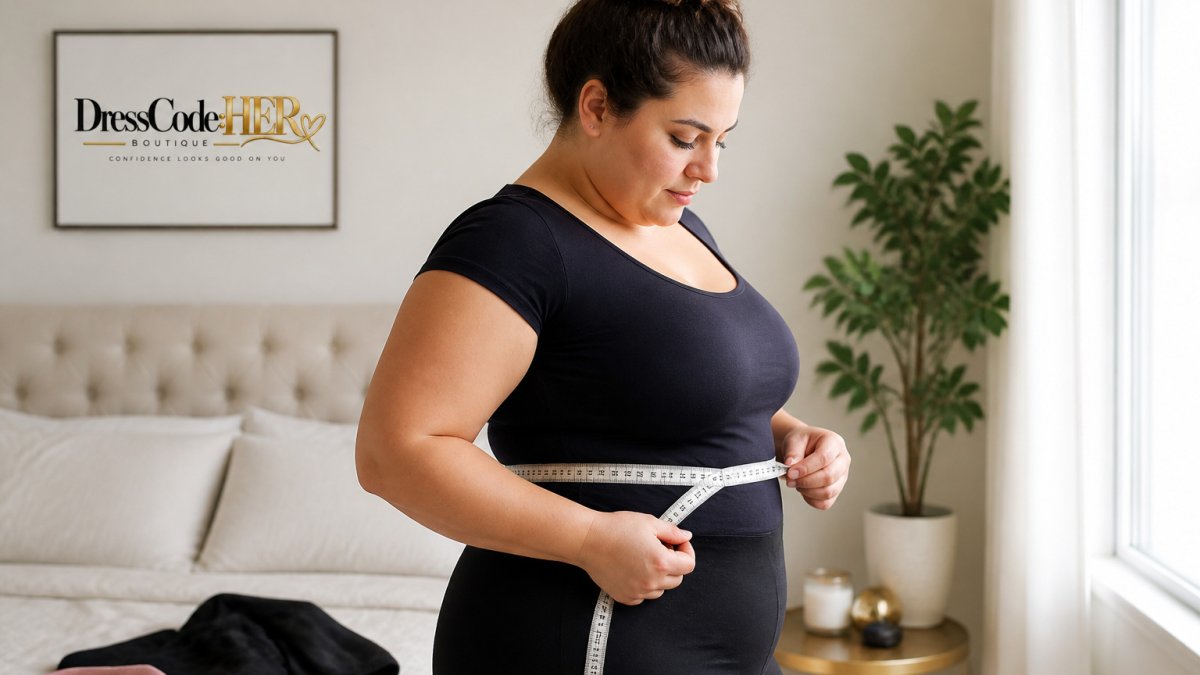
Accurate measurements are the foundation of any plus size clothing fit guide in 2026 that shoppers can rely on. Use a soft tape measure, keep it level, and do not pull it tight. Measure over underwear or light clothing, standing relaxed with feet together.
Bust, Waist and Hip Measurements
Measure the fullest part of the bust, keeping the tape horizontal across the back. Measure the natural waist, which usually sits at the narrowest point above the navel. For hips, measure the fullest part of the seat, typically around 20 to 22 cm below the waist, though this varies by body shape.
Write each number down before you compare them to any chart. Guessing from memory is the most common reason people order the wrong size.
Measuring Length, Rise and Inseam
For tops, measure from the high point of the shoulder down to where you want the hem to land. For trousers and jeans, measure the inseam from the crotch to the ankle on a pair of trousers that already fit you well. Rise, the distance from the crotch to the waistband, matters just as much and is often ignored.
How to Read a Plus Size Clothing Size Chart
Size charts are often misread, and the confusion is understandable: many charts list garment measurements, not body measurements. A chart may show a bust of 112 cm, but that is usually the finished garment's circumference, which already includes ease, the room built in for movement and comfort. If you compare that number directly to your body measurement without accounting for ease, you will order the wrong size.
Step-by-Step: Decoding Any Size Chart
- Identify the measurement type. Look for a note that says "garment measurements" or "body measurements." If it says garment, you will need to add ease. If it says body, the chart is telling you which body size the garment is designed for.
- Check the unit. Charts may use centimetres or inches. Mixing them up is a common error. If your tape measure is in inches and the chart is in centimetres, convert before comparing.
- Compare like with like. Measure your bust, waist, and hips as described in the previous section. Then compare each to the corresponding garment measurement. The difference is the ease. A fitted top might have 2-5 cm of ease at the bust; a relaxed blouse might have 10 cm or more.
- Look for a size-between-sizes option. Many plus size brands now offer in-between sizes (e.g., 18W, 20W, 22W). If your measurements fall between two sizes, compare your bust, waist, and hip separately, you may need one size for the top and another for the bottom.
A Repeatable Method for Brand-to-Brand Comparison
Because sizing is not standardised, the same label can fit differently across brands. Here is a method to compare a retailer's chart with your own measurements and a garment you already own:
- Take a garment that fits you well and lay it flat. Measure the bust (armpit to armpit, then double), waist (across the narrowest point, then double), and hips (across the fullest point, then double). Write these down.
- Compare these flat measurements to the retailer's chart. If the chart lists flat measurements, you can compare directly. If it lists circumference, double your flat measurements first.
- Check the fabric. A stretch knit will accommodate a range of measurements, while a rigid woven will not. If the garment has stretch, you have more leeway; if not, match your measurements closely to the garment's.
When to Size Up or Down
- Size up if you are between sizes and the garment is rigid (no stretch), if you plan to layer underneath, or if you prefer a relaxed fit.
- Size down if the fabric has significant stretch and recovery, if you prefer a fitted look, or if the brand's reviews consistently say the item runs large.
Remember that a size chart is a starting point, not a guarantee. Use it alongside your measurements, fabric knowledge, and the brand's fit feedback to make a confident choice.
Plus Size Clothing Sizing Explained: Sizes, Numbers and In-Between Fits
Sizing systems range from numbers to letters, and they are not standardised. A 20W from one maker can measure more generously than a 20W from another.
Plus Size Knit Linen Dolman Ruched Top →
When you sit between sizes, a common approach is to size up for woven fabrics that do not stretch and to stay true to size for generous knits.
Sizing varies by brand, so the table below sums up the sizing points the article makes.
| Point | What the article says |
|---|---|
| Size label | A starting point, not a guarantee |
| Same label, different brands | Can measure differently |
| Between sizes, woven fabric | Size up |
| Between sizes, generous knit | Stay true to size |
| Waist vs bust | Sizing up can help bust; sizing down can reduce waist excess |
Plus Size Jeans Fit Guide: Rise, Seat, Thigh and Leg
Jeans are where fit problems show up most clearly. Rise decides whether the waistband sits comfortably or digs in. Seat measurement determines whether the back pockets sag.
Stretch denim helps with comfort, but it can also lose shape after repeated wear. For more on how to dress for your curves, see our guide on How to Dress for Your Curves.
Once you know your rise and seat measurements, you can browse our plus size bottoms to try those fits in person.
How Fabric, Stretch and Construction Change the Fit
Fabric choice changes fit more than most shoppers realise. A knit with some spandex tends to recover its shape after wear, while a rigid fabric keeps its structure but leaves less room to move.
Ease, the extra room in a garment, is what makes clothes comfortable. Too little ease causes pulling across the bust or hips. Too much makes a top look shapeless.
Fit Troubleshooting Garment by Garment, and Your Next Step With Dress Code: HER
Even with accurate measurements, fit problems happen. The key is to diagnose the cause before you decide to return, size up, or tailor. Below is a garment-by-garment troubleshooting guide for the most common issues plus size shoppers face.
Tops and Blouses
- Gaping at the bust: The garment is too small across the chest. Check the bust measurement on the chart against your own. If the difference is less than 2 cm, size up. Alternatively, look for tops with princess seams or a bit of stretch.
- Pulling across the back: The shoulder seam may be too narrow, or the armhole is cut too small. Try a larger size or a cut with more room through the shoulders and armscye.
- Tight upper arms: This is a common fit issue in plus size tops. Look for sleeves with a wider cut or dolman sleeves, which provide extra room. If the rest of the top fits, a tailor can sometimes let out the sleeve seam.
Dresses
- Waist sits too high or too low: This is usually a torso length issue, not a width issue. Measure the garment's torso length (from shoulder to waist seam) and compare it to your own torso length. If the difference is more than 2-3 cm, the dress may not work without alterations.
- Pulling across the hips: The dress may be too small through the hips. Size up if the fabric is rigid; if it has stretch, you may be able to wear it, but check for stress wrinkles.
- Gaping at the armhole: Often caused by a bust that is too large for the dress's cut. Look for dresses with adjustable straps or a wrap style that allows you to customize the fit.
Jeans and Trousers
- Waistband gapes at the back: This is common if you have a shorter rise or a curvier seat. Look for jeans with a higher rise or a contoured waistband. A tailor can also take in the back waistband.
- Seat sags: The seat measurement is too large. Try a smaller size or a cut with a more fitted seat. If the waist fits but the seat sags, a tailor can adjust.
- Thighs too tight: Look for jeans with a relaxed thigh or a straight leg. Stretch denim helps, but check that it recovers its shape.
Outerwear
- Coat too tight across the back: You need a size that fits over your heaviest layer. Size up if you plan to wear bulky sweaters underneath.
- Sleeves too short: Check the sleeve length measurement on the chart. If you have long arms, look for coats with longer sleeves or consider a tailor.
- Excess fabric at the waist: A belted coat can cinch the waist without needing alterations.
When to Return, Tailor, or Keep
- Return if the garment is too small in multiple areas, if the fabric is uncomfortable, or if the alterations needed would cost more than the item.
- Tailor if the garment fits well in most areas but needs minor adjustments (e.g., taking in the waist, shortening sleeves).
- Keep if the fit is comfortable and the issues are minor or can be styled around (e.g., adding a belt).
Once you have diagnosed your fit needs, browse our plus size outerwear for coats that fit over layers, or explore our dresses for pieces that suit your measurements. Our plus size knit linen dolman ruched top is a good example of a relaxed fit with adjustable ruching, and the plus size fit and flare scuba crepe dress shows how princess seams shape a dress without clinging. For accessories that define the waist, the vintage disc elastic plus size belt adds structure to flowing garments.


Frequently Asked Questions
Is size 20 a 2X or 3X?
Size 20 is generally equivalent to a 2X in many US-based ranges, though it varies by brand. Size charts differ from one label to another, so the reliable way to decide is to compare your bust, waist and hip measurements against the specific brand's garment measurements rather than relying on the number alone. Dress Code: HER lists measurements on its size guides, so check those against your own tape measurements before ordering.
How do I measure myself for plus size clothing?
Use a soft tape measure and keep it level. Measure the fullest part of your bust, the natural waist (the narrowest point, usually just above the navel), and the fullest part of your hips, with feet together. Stand relaxed, don't pull the tape tight, and wear light underwear. Write down each number, then compare them to the brand's garment measurements, not just its size label. For length and inseam, measure from shoulder to hem and from crotch to floor.
Should I size up or down when shopping for plus size clothing?
Choose based on your measurements first, then your fit preference. If your bust or hips fall between two sizes, sizing up usually gives comfort and room for movement, while sizing down can work for structured pieces you want closer to the body. Stretch fabrics such as the scuba crepe dress and the knit linen top tolerate small variations better than rigid woven fabrics. Check each product's size guide before deciding.
How do I choose the right plus size jeans fit?
Start with your hip and seat measurement, since that is the hardest part to alter. Then check rise: a mid or high rise sits more comfortably over fuller hips and avoids gapping at the back. Look at thigh and leg width as well, as a fitted leg may pull across thighs. Stretch denim with some elastane gives movement, but make sure the waistband is not so tight it digs in when you sit. A good test is to sit, squat and bend in the fitting room.
What should I look for in plus size clothing fabric and construction?
Look for fabric content and construction details that match the garment's purpose. Blends with spandex, such as the 95% polyester and 5% spandex scuba crepe dress or the draped cowl blouse, provide stretch and recovery that help the piece skim without clinging. Knit linen blends like the Dolman top are breathable and forgiving. Side gathering, princess seams and adjustable drawstrings let you customize fit. Always read the product details rather than assuming all stretch fabrics fit alike.
